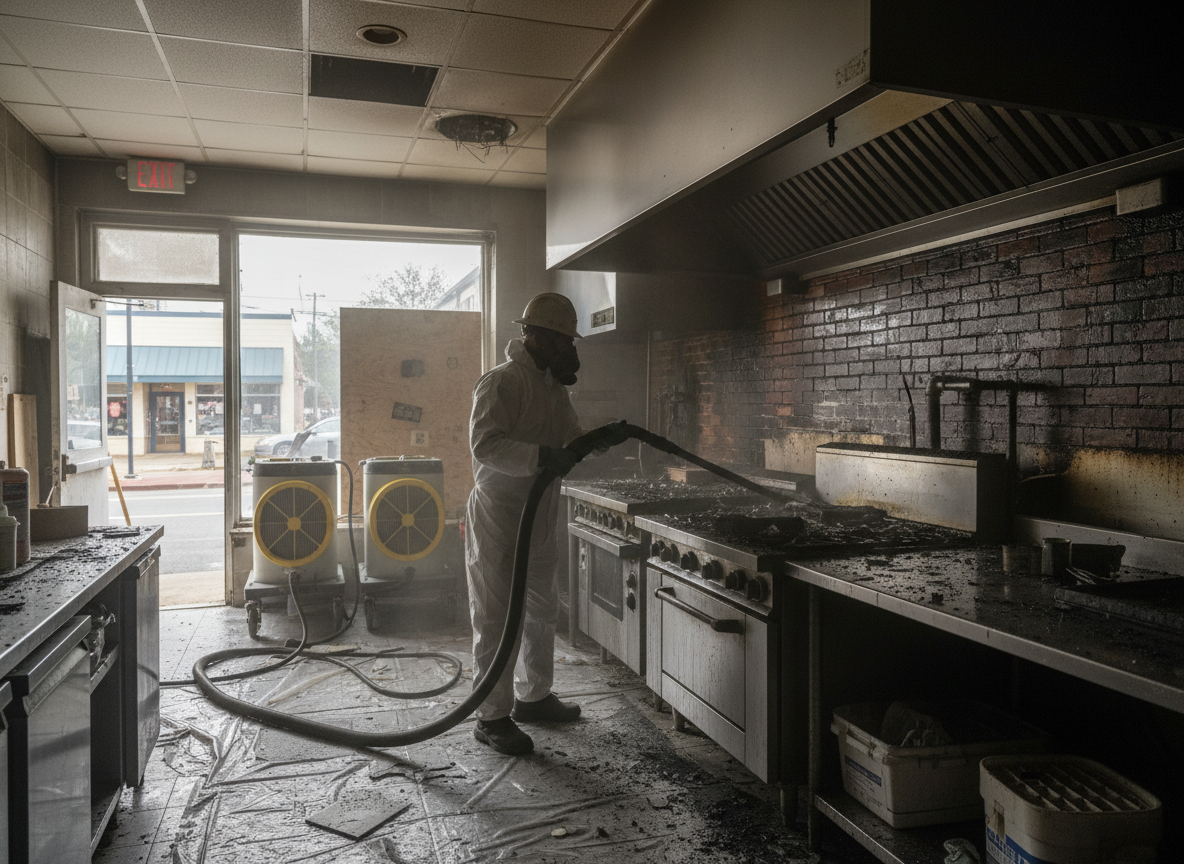
Commercial properties in Saugus often sit in buildings from the mid-1900s with plaster walls, knob-and-tube wiring remnants and flat roofs that trap heat and smoke. When fire breaks out in East Saugus or Cliftondale retail spaces, soot travels through shared HVAC runs into neighboring tenant spaces, requiring compartment-by-compartment negative-pressure cleaning rather than whole-building fogging. Cold winter air pulls acidic smoke deeper into brick and concrete, so crews must neutralize surfaces before temperatures drop below freezing to prevent etching.
In Oaklandvale and Golden Hills light-industrial zones, metal decking and single-ply membranes on roofs can delaminate after heat exposure. Restoration teams isolate these areas early because melt water from snow load mixes with residue and drives corrosion into steel joists. Work near the Saugus Iron Works National Historic Site or Breakheart Reservation also triggers extra containment to keep particulates from drifting into protected wetlands or historic masonry.
Nearby cities such as Lynn, Malden, Melrose and Peabody share the same humid continental pattern of cold winters and warm summers, so seasonal timing affects drying schedules. Commercial jobs scheduled after a nor'easter need supplemental heat and dehumidification that accounts for higher groundwater in low-lying North Saugus lots. Crews document every step for insurance adjusters because mixed commercial-residential buildings require separate scopes for each occupancy type.
Edge cases include restaurants with grease-laden exhaust systems and medical offices with sensitive equipment. Both demand source removal before any ozone or thermal fog application, and crews must verify that fire-rated assemblies remain intact per current Massachusetts building code after repairs.
Technician insight
In Saugus the thing that catches most people out with Commercial fire restoration is how quickly winter humidity condenses on cold steel joists after a fire, turning light smoke film into active corrosion inside roof decks in North Saugus and Lynnhurst. Older mixed-use buildings near Saugus Town Hall often share wall cavities that let soot travel two or three units away, so skipping compartment testing always costs more later.
Retail Strip Fire, East Saugus
A kitchen exhaust fire spread soot through a shared plenum into three storefronts on a Cliftondale commercial block. We isolated each unit, removed grease-laden residue from the common duct, and ran negative air for ten days until winter temperatures arrived. All three businesses reopened with passing air-quality tests and no recurring odor.
How it works
- 1
Site Assessment and Containment
Technicians arrive 24/7, secure the perimeter with physical barriers, and map smoke migration paths through the commercial structure using moisture meters and thermal imaging.
- 2
Debris Removal and Hazard Mitigation
Loose charred materials are removed, electrical and HVAC systems are isolated, and corrosive residues are neutralized to protect remaining structural elements.
- 3
Detailed Cleaning and Odor Control
HEPA vacuuming, soda blasting and chemical neutralization address soot on all surfaces; air scrubbers run continuously until readings meet clearance standards.
- 4
Drying, Repairs and Documentation
Affected areas are dried with commercial equipment, code-compliant repairs are completed, and a full photo and moisture log is prepared for the property owner and insurer.
Pricing
Scope and access determine cost; every commercial project receives an itemized upfront quote before work begins.